Newswise News Feed

Loading Newswise Feed...

Showing posts with label flu. Show all posts

Tuesday, September 29, 2009

Tamiflu Metabolite Measured in Japanese Sewage Discharge, River Water

Tamiflu Metabolite Measured in Japanese Sewage Discharge, River Water - This story, posted to Newswise on Monday, September 29, has attracted quite a lot of attention, particularly as the H1N1 flu virus continues to affect concerns about the upcoming flu season.

Tamiflu is arguably the most popular over-the-counter treatment, and is considered a viable option to at least speed up recovery if you've already come down with the flu. One potential complication, however, is that trace amounts of Tamiflu's active ingredient, oseltamivir carboxylate (OC), is now showing up in treated sewage and river water.

From the article:

"[I]n the peer-reviewed journal Environmental Health Perspectives (EHP), researchers measured oseltamivir carboxylate (OC), the active metabolite of the popular anti-influenza drug Tamiflu (oseltamivir phosphate), in samples of sewage discharge and river water collected near Kyoto City during Japan’s 2008–2009 flu season."

The results indicate the potential damage these trace amounts of OC could cause:

"...the peak drug concentrations observed in this study may be high enough to promote the emergence of drug-resistant influenza strains in waterfowl exposed to OC-contaminated waterways."

Researchers continue to examine the possibility of drug-resistant viruses, so watch Newswise for the results of those future studies. Follow our Feature News Channels on Drug-Resistant Superbugs and a Breaking News Channel on H1N1 Influenza.

read the full article...

Monday, April 27, 2009

Swine Flu Experts on Newswise

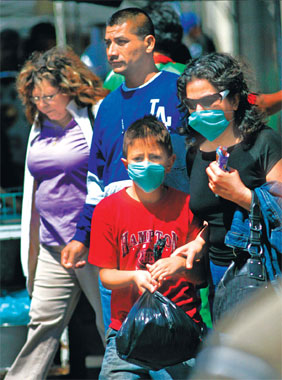
On Monday, April 27, 2009, the official swine flu outbreak death toll in Mexico reached 149, as reported by the Washington Post.  As frightened Mexican citizens try to avoid contracting the virus, the nation is practically under a voluntary quarantine. Schools are closed until May 6.  Mexican futbol teams play in empty stadiums.  Those brave enough to go out in public are encouraged to wear surgical masks. 

As public health officials keep a close eye on the outbreak, experts predict that infection rates may escalate and spread north to the U.S. and beyond.  Governments are already recommending against any non-essential travel to the U.S. from Europe, as reported by the AP today.

Newswise has created a Breaking News Channel dedicated to Swine Flu and experts on the outbreak.

Among the latest experts available:

Charles Ericsson, M.D., professor of internal medicine and director of Travel Medicine at The University of Texas Medical School at Houston.  He answers 20 common questions about what you should know about the swine flu, including what are the symptoms, how long are people contagious, and what treatments are available. 

Health and science experts from Temple University.  These specialists can comment on a number of areas related to the outbreak, including: understanding the disease, preparedness and prevention of outbreak, and how the virus is spread.

More experts are being added throughout the day.  View them at the Breaking News Channel: Swine Flu Epidemic.  Other experts on general public health and infectious disease topics can be found at the Newswise Feature Channel: Infectious Diseases.

read the full article...

Tuesday, March 3, 2009

Caution Urged When Giving Kids Cold and Flu Meds

It's cold and flu season, which means misery for kids and the parents trying to help them. But doctors are asking parents to resist the urge to give children under the age of 6 over-the-counter cough and cold medication.

Such drugs can have serious side effects on the smallest of children, the Food and Drug Administration warns. Side effects include hives, drowsiness, difficulty breathing and even death.

"Some 7,000 children end up in the emergency room each year because of problems associated with these medicines," says Esther Yoon, M.D., general pediatrician in the Department of Pediatrics and Communicable Diseases at the University of Michigan Health System.

Roughly two-thirds of incidents occurred after children drank medication while unsupervised, according to the Centers for Disease Control and Prevention. Most problems have occurred as a result of dosing errors.

To ease pain from a harsh cough or throat pain, doctors recommend using over-the-counter acetaminophen and ibuprofen in age-appropriate doses, Yoon says.

To relieve symptoms, doctors recommend the following:

  • For blocked noses, parents should use nasal saline drops and a bulb suction to loosen up and remove mucus or have the child blow their nose.
  • For coughs, the child should be given a teaspoon of honey or corn syrup if over the age of 1. Have the child drink warm fluids like water, apple juice and chicken broth to help with coughing.
  • Take the child into the bathroom and run a hot shower. The steam relaxes the airways and helps with coughing spasms.
  • Increase the humidity in the home to help reduce nasal congestion and coughing.

Parents can help prevent colds by washing hands frequently, using instant hand sanitizers, teaching children to cover their mouth and nose when they cough or sneeze, and making sure children are well hydrated, have good nutrition and are getting enough sleep.

"Other good tips include disinfecting the home, kitchen countertops, door knobs and toys," Yoon says. "Children should get plenty of vitamin C and E to help fight germs and a multivitamin is also helpful."
Cold symptoms caused by a virus typically last between four and five days. But if they continue for more than five days, Yoon recommends taking the child to a doctor.

If a child is having difficulty breathing or is wheezing, he or she should be seen right away. Infants younger than 3 months old with a fever should also be seen right away.

read the full article...

Tuesday, December 30, 2008

Scientists Isolate Genes That Made 1918 Flu Lethal

By mixing and matching a contemporary flu virus with the “Spanish flu” — a virus that killed between 20 and 50 million people 90 years ago in history’s most devastating outbreak of infectious disease — researchers have identified a set of three genes that helped underpin the extraordinary virulence of the 1918 virus.

Writing today in the Proceedings of the National Academy of Sciences, a team led by University of Wisconsin-Madison virologists Yoshihiro Kawaoka and Tokiko Watanabe identifies genes that gave the 1918 virus the capacity to reproduce in lung tissue, a hallmark of the pathogen that claimed more lives than all the battles of World War I combined.

“Conventional flu viruses replicate mainly in the upper respiratory tract: the mouth, nose and throat. The 1918 virus replicates in the upper respiratory tract, but also in the lungs,” causing primary pneumonia among its victims, says Kawaoka, an internationally recognized expert on influenza and a professor of pathobiological sciences in the UW-Madison School of Veterinary Medicine. “We wanted to know why the 1918 flu caused severe pneumonia.”

Autopsies of 1918 flu victims often revealed fluid-filled lungs severely damaged by massive hemorrhaging. Scientists assumed that the ability of the virus to take over the lungs is associated with the pathogen’s high level of virulence, but the genes that conferred that ability were unknown.

Discovery of the complex and its role in orchestrating infection in the lungs is important because it could provide a way to quickly identify the potential virulence factors in new pandemic strains of influenza, Kawaoka says. The complex could also become a target for a new class of antiviral drugs, which is urgently needed as vaccines are unlikely to be produced fast enough at the outset of a pandemic to blunt its spread.

To find the gene or genes that enabled the virus to invade the lungs, Kawaoka and his group blended genetic elements from the 1918 flu virus with those of a currently circulating avian influenza virus and tested the variants on ferrets, an animal that mimics human flu infection.

For the most part, substituting single genes from the 1918 virus onto the template of a much more benign contemporary virus yielded agents that could only replicate in the upper respiratory tract. One exception, however, included a complex of three genes that, acting in concert with another key gene, allowed the virus to efficiently colonize lung cells and make RNA polymerase, a protein necessary for the virus to reproduce.

“The RNA polymerase is used to make new copies of the virus,” Kawaoka explains. Without the protein, the virus is unable to make new virus particles and spread infection to nearby cells.

In the late 1990s, scientists were able to recover genes from the 1918 virus by looking in the preserved lung tissue of some of the pandemic’s victims. Using the relic genes, Kawaoka’s group was able to generate viruses that carry different combinations of the 1918 virus and modern seasonal influenza virus.

When tested, most of the hybrid viruses only infected the nasal passages of ferrets and didn’t cause pneumonia. But one did infect the lungs, and it carried the RNA polymerase genes from the 1918 virus that allowed the virus to make the key step of synthesizing its proteins.

In 2004, Kawaoka and his team identified another key gene from the 1918 virus that enhanced the pathogen’s virulence in mice. That gene makes hemagglutinin, a protein found on the surface of the virus and that confers on viral particles the ability to attach to host cells.

“Here, I think we are talking about another mechanism,” Kawaoka says. The RNA polymerase is used to make copies of the virus once it has entered a host cell. The role of hemagglutinin is to help the virus gain access to cells.

In addition to the study’s lead authors, Watanabe and Kawaoka, co-authors of the new PNAS paper are Shinji Watanabe, Jin Hyun Kim and Masato Hatta, also of UW-Madison; and Kyoko Shinya of Kobe University. The work was funded by the Japanese Ministry of Education, Culture, Sports, Science and Technology and by grants-in-aid from the Ministry of Health, Labor and Welfare of Japan.

read the full article...